
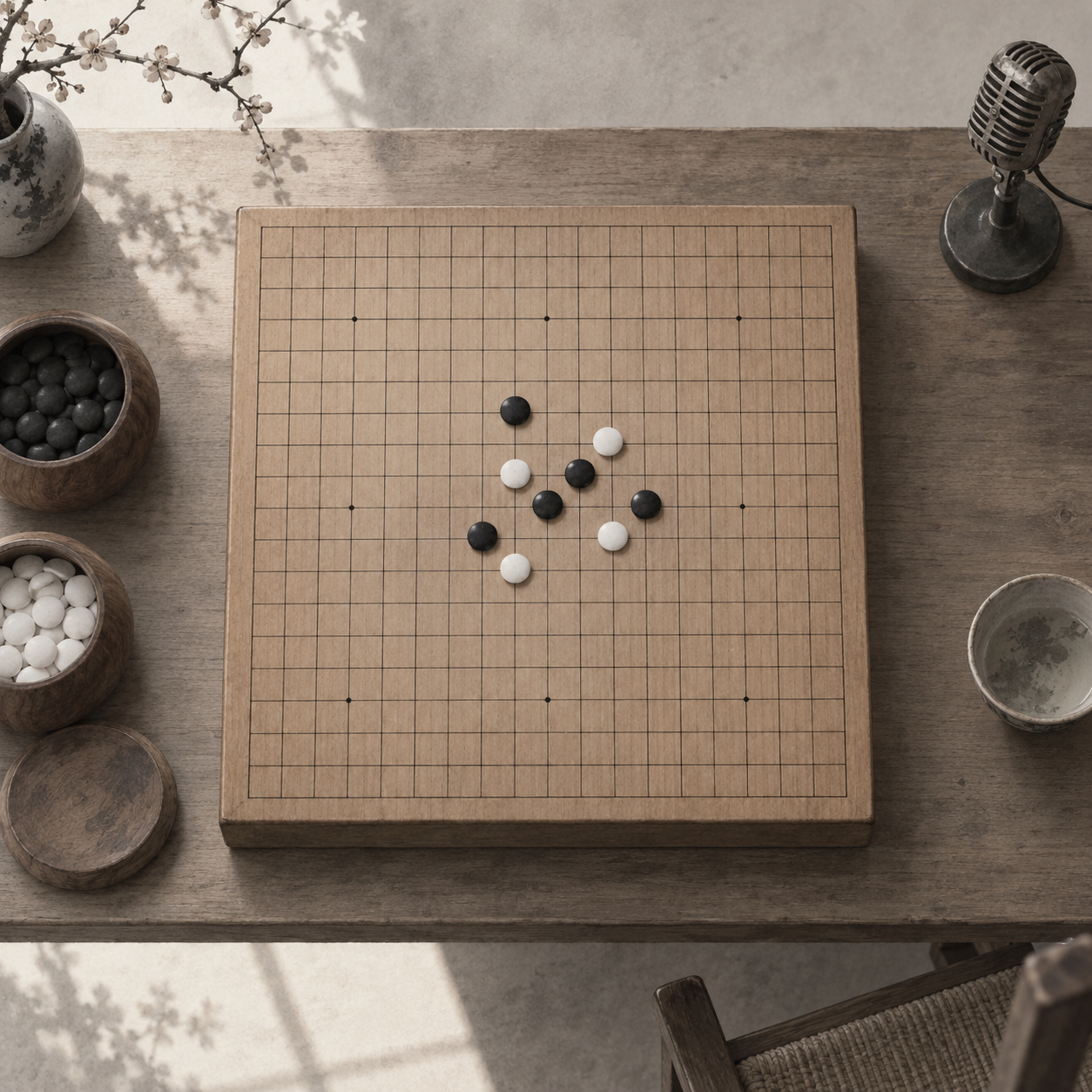
In 1990, Na Wei and a dozen or so fellow enthusiasts formed the Kyoto Gomoku Team. Five years later, Na traveled alone to Tallinn, placed 28th in an international open and became the first Chinese player to appear at an international Renju event, according to Wikipedia’s account of Renju’s development in China. Chinese players would go on to win world titles, and the Chinese Chess Academy would assume China’s place in the Renju International Federation. Between those milestones lay club games, tournament entries, written rules and a transfer of representation: different kinds of work, each carrying the game forward.
1990: The Kyoto Gomoku Team
The Kyoto Gomoku Team was a club formed by enthusiasts and China’s first modern specialist Gomoku organization outside official institutions. Its founders brought players together and arranged games themselves, according to Wikipedia’s account of Renju’s development in China. The team gave people who had largely played on their own a dependable place to meet. Its structure grew out of the games they organized and the ideas they exchanged across the board.
1995–1996: Tallinn and Television
In July 1995, Na Wei traveled alone to Tallinn, Estonia, for the international open (BT) at the fourth World Renju Championship. He finished 28th. It was the first appearance by a Chinese player at an international Renju event, according to Lijing Renju Classroom’s overview of Gomoku in China. The trip put a Chinese player at an international board for the first time. His placing matters, as does the division in which he earned it.
In 1996, RIFCHINA, a Chinese Gomoku organization formed outside official institutions, joined the Renju International Federation, according to Wikipedia’s account of Renju’s development in China. That year, CCTV-5 began airing televised Renju lessons presented by Na Wei and Peng Jianguo, according to CCTV’s account of Gomoku as a meeting point of Chinese and Western cultures. One development connected a domestic organization to the international federation. The other let you follow the game’s possibilities without setting foot in a club.
1999: Beijing and Its Divisions
In July 1999, Beijing hosted the sixth World Renju Championship. More than 70 players from 11 countries took part, according to Lijing Renju Classroom’s overview of Gomoku in China. The event included both a final division and an international open. Beijing welcomed players from abroad while giving Chinese competitors a chance to play internationally at home. To make sense of that year’s results, you first need to know which division each placing belongs to.
Chinese players placed in three divisions in Beijing: Zhang Jinyu finished ninth in the final division (Group A), Bai Tao won the international open (BT), and junior player Lu Yao finished fourth in the women’s division, according to Wikipedia’s account of Renju’s development in China. Group A and BT were separate competitions; Bai’s first place was a BT result. Read together, the placings show the range of home-country participation without turning distinct divisions into one.
2001–2003: Correspondence Play and Written Rules
Zhang Jinyu was runner-up at the World Correspondence Renju Championship in both 2001 and 2002. Chen Wei won it in 2003, according to Wikipedia’s account of Renju’s development in China. Correspondence play takes place by post or online, not across a tournament table. These were correspondence titles and placings, distinct from results in the in-person individual world championship.
In August 2003, the Chinese Gomoku Competition Rules, compiled under the Chinese Chess Academy’s direction, were published for the first time. On December 21, the academy issued a provisional Chinese Gomoku Ranking System, according to China Renju Network’s notes on the revision of the competition rules. One document set out how games are played and decided; the other gave player ranks a written basis. Renju uses a 15-by-15 board. Black loses by making a double-three, a double-four or an overline; an overline by White counts as a win. Early World Renju Championships also used RIF rules intended to balance the first move, including an option to swap after three moves and a choice between two fifth moves, according to China Renju Network’s Chinese Renju (Gomoku) competition rules.
Written rules gave every game a common measure
2007: An Individual World Title
The World Renju Championship has been held every two years since 1989. On August 15, 2007, Wu Di won the final division at the tenth championship, becoming the first Chinese player to win its in-person individual world title, according to Wikipedia’s account of Renju’s development in China. The division is part of the story. It identifies the title Wu won and distinguishes it from the international-open result in Beijing eight years earlier.
2010–2015: Team Play and a Return to Beijing
China won the World Team Renju Championship for the first time in 2010, according to Wikipedia’s account of Renju’s development in China. A team title belongs to a team; an individual championship belongs to a player. Keeping those records separate lets you see the different ways Chinese competitors succeeded internationally.
Cao Dong won the 12th World Renju Championship in 2011. Beijing hosted the World Team Renju Championship in 2012, and Qi Guan won the 14th World Renju Championship in 2015, according to Wikipedia’s account of Renju’s development in China. Beijing hosted a team event; Cao’s and Qi’s results came in in-person individual competition. The dates are close, but the events and their divisions remain distinct.
2018: A Change in Representation
China won its second World Team Renju Championship in 2018, eight years after its first, according to Wikipedia’s account of Renju’s development in China. A transfer of federation representation took place that year, too, but it was an organizational matter, not a tournament result. One record tells you how a team performed; the other tells you who represented China in the international federation.
Games are won and lost. Federation seats change hands.
In June 2018, the Chinese Chess Academy replaced RIFCHINA and formally joined the Renju International Federation as the representative of the People’s Republic of China, according to Wikipedia’s account of Renju’s development in China. An organization begun by enthusiasts had given way, in the federation, to the national chess academy. The transfer changed who spoke for China there. It was connected to the game’s growth, but it left a different kind of record from any victory on the board.