
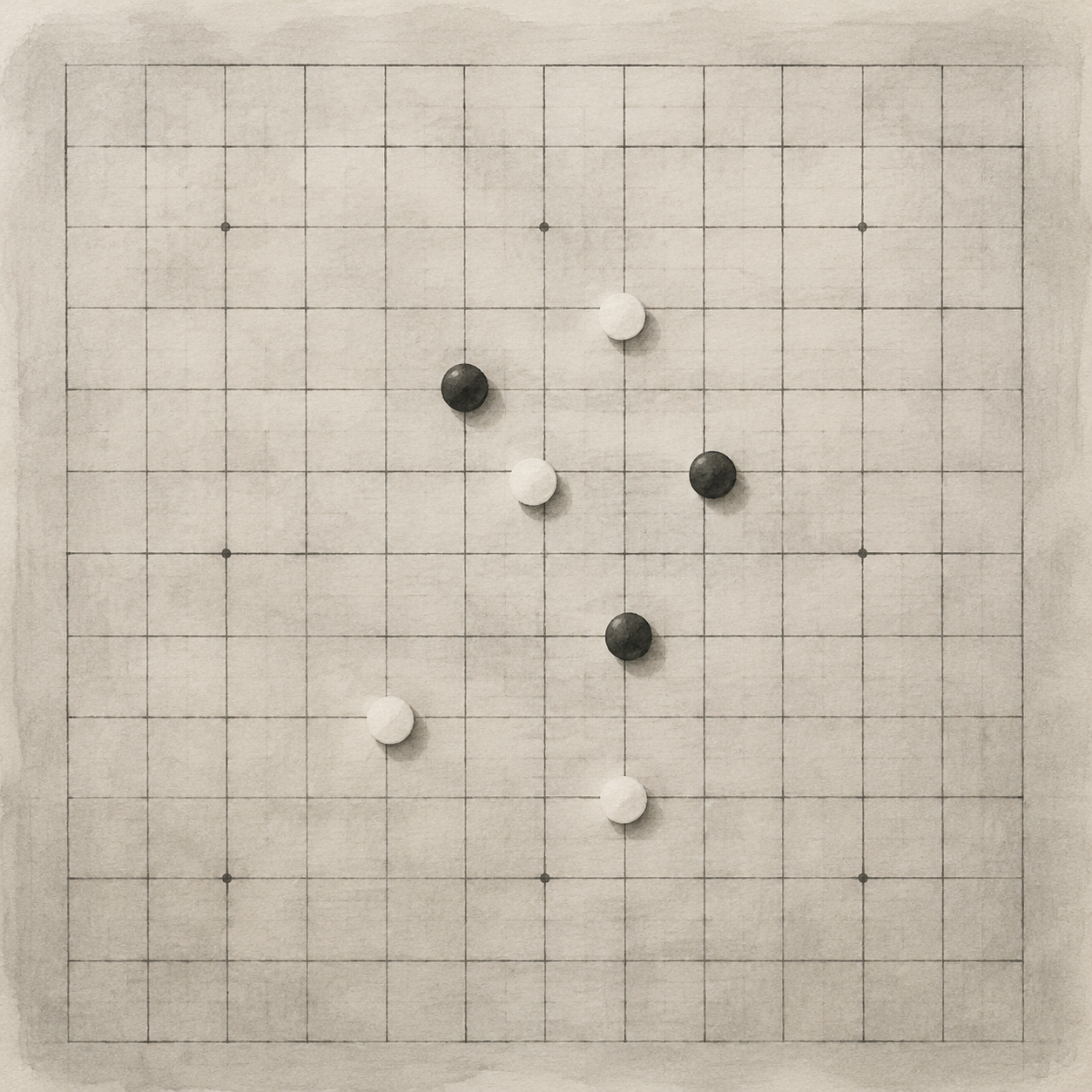
You may have seen this position: the game has reached the middle stage, clues have spread across half the board, and although you can sense the opponent’s threat, you cannot quite say where the real danger is. A larger board gives you more room. It also gives you more noise. Renju eventually settled on 15×15 not merely to make the board smaller, but to polish the game’s rules and scale, making first-move advantage, forbidden-move calls, and the pace of spectating easier to read.
Start with the fact: Renju is played on a 15×15 board
To talk about Renju today, you first have to name the board. RenjuNet’s rules state plainly that Renju uses a 15×15 line board. This is not an arbitrary size; it is part of modern Renju’s ruleset.
The same goal, five stones in a line, has lived on different boards in different traditions. Wikipedia’s entry on Gomoku also notes that today Gomoku is traditionally played on 15×15, while 19×19 was once a common standard.
So the question is not “why must Gomoku be 15×15?” The sharper question is this: when Renju branched away from ordinary Gomoku, why did it need a tighter, more refined size?
A 19×19 board gives freedom, and gives the first player more room to roam
The 19×19 board comes from the world of Go: spacious, open, expansive to the touch. In a five-in-a-row game, it makes the early layout more diffuse. A move can drift far from the fight, threats can be deferred across a wider field, and the position may take a long time to become truly close.
That does not make the larger board bad. It simply lengthens the time spent looking for the battlefield. In a casual game, that may have its own aftertaste. But for Renju, which needs stable rulings and a stable tournament rhythm, too much blank space can loosen the central conflict.
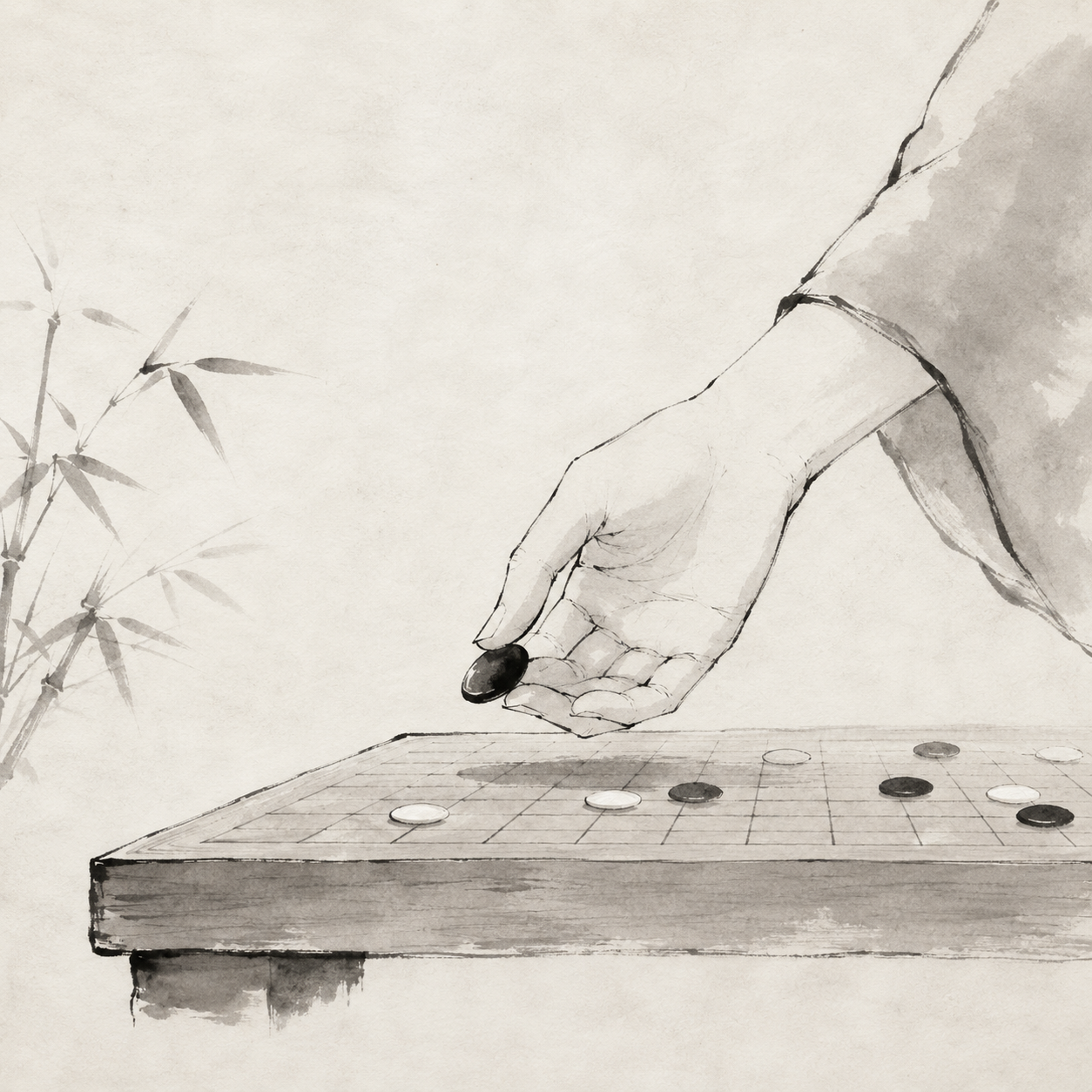
15×15 brings the opening fight forward
Once the board is tightened to 15×15, the first choices around tengen begin to connect more quickly. If you place a stone near the center, your opponent cannot easily detour completely around it: the edges are closer, and lines of play are compressed sooner.
This is a design logic, not a quotation from a rulebook. A smaller board reduces wandering openings and makes the first, second, and third moves relate more tightly. The opening is no longer just about claiming territory. It starts to feel like setting the breathing pattern of the game.
When the board shrinks, the conflict becomes clearer.
Renju’s central problem is Gomoku’s first-move advantage
RenjuNet’s history of the game is direct: Renju developed from Gomoku about a century ago because ordinary Gomoku no longer satisfied strong players. The key is not only that “masters wanted something harder.” It is that, under ordinary rules, the first player could too easily snowball an advantage.
In Gomoku without added restrictions, Black moves first. If Black can keep creating open threes, four-in-a-row threats, and double threats, White is often forced into defense move after move. The larger the board, the more Black can sometimes scatter threats into the distance, wearing down White’s judgment.
Renju’s answer was not just to change the board. It also introduced a system of forbidden moves, using rules to limit certain overpowered Black formations, such as double-three, double-four, and overline. Only when you read board size together with forbidden-move rules do you get close to what Renju really is.
Forbidden moves need a clear field of judgment
Forbidden moves suffer most from ambiguity. Does a double-three really exist? Has a double-four appeared at the same time? To judge it, you have to read the lines, the endpoints, and whether the follow-up can genuinely become a threat. The more scattered the board, the easier it is for spectators to be pulled away by distant possibilities.
Here, the value of 15×15 is restrained. It does not erase complexity. It presses complexity into a range that can be observed. Referees, opponents, and spectators can more easily follow the same thread.
15×15 also makes tournament time easier to tune
A match happens not only on the board, but inside time. An oversized board expands the search space, especially early on, before contact is clear; thinking gets diluted by many points that “might be possible.”
15×15 keeps the field of choice rich without making it boundless. The game enters real attack and defense more readily, and time controls can settle into a steadier rhythm. The beauty here is quiet: not fewer variations, but less useless drift.
BoardGameGeek describes Renju as the adult, competitive version of Gomoku, and notes that it is played on a 15×15 board. That is only a summary, but it catches an intuition: when a game becomes a contest, it needs more than difficulty. It needs reproducible order.
From 19×19 to 15×15 is a move from margin to density
If 19×19 is a broad sheet of paper, 15×15 is a tighter text block. It is not necessarily more “advanced,” but it better suits the problem Renju set out to solve: making the sharpness of five in a row appear sooner, and bringing every move closer to the result.
That is also why “it looks good” is not a shallow reason on a board. A good scale makes you want to keep looking. The distance between stones has tension, the blank space does not shout, and the variations have texture.
A good board makes judgment quiet.
Next time you watch Renju, look first at what the board restricts
You do not have to mythologize 15×15 to understand it. It is not the only reason Renju works, nor is it some absolutely perfect answer. It is more like a tool that has survived repeated use: a comfortable size, clear boundaries, and enough precision to carry the details of forbidden-move rules.
The next time you watch a Renju game, begin with the first three moves. How far are they from tengen? Do they create contact quickly? Is Black already being shaped by the shadow of forbidden moves? Once you see these things, 15×15 stops being just a number.
If you want to feel that sense of scale in your hands, play a 15×15 game. Slow down and read the lines; do not rush toward five. You may find that once the board is smaller, the questions become clearer.