
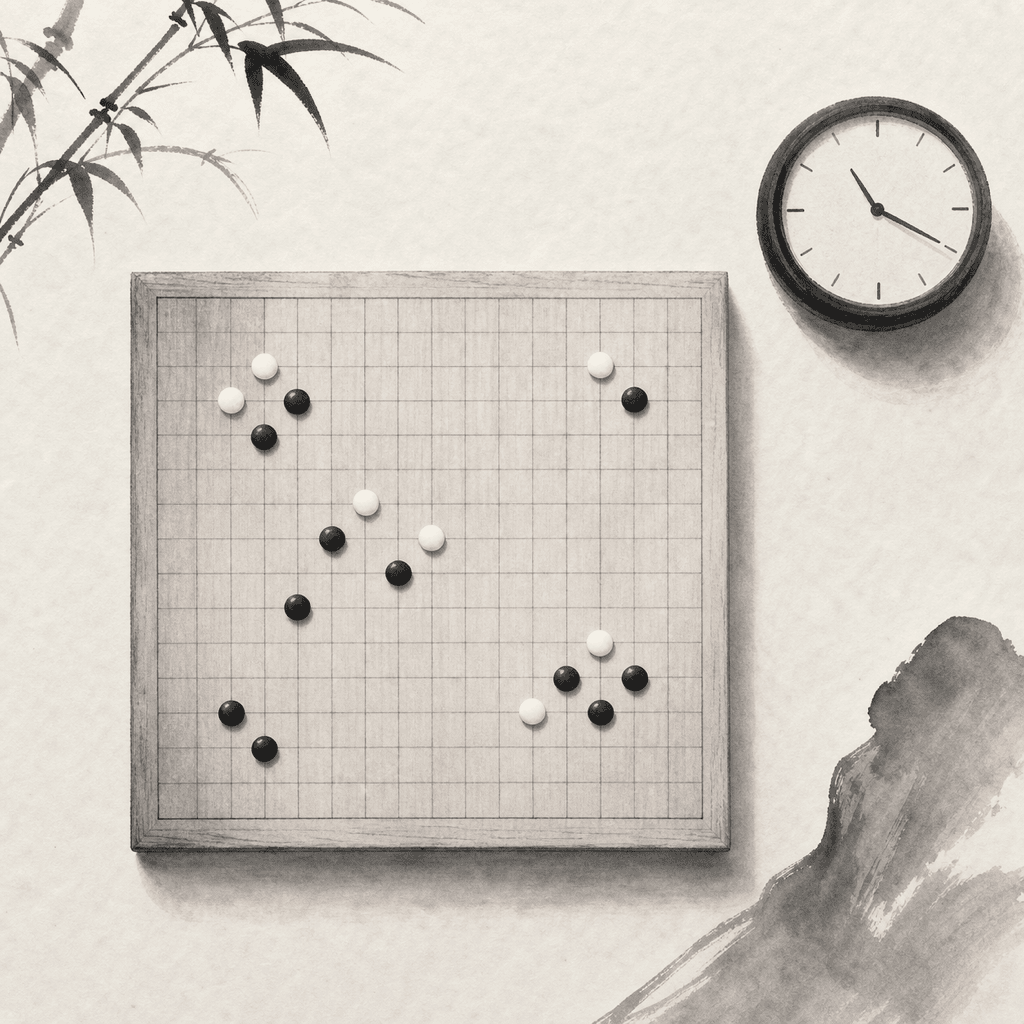
When you watch a team match, the most anxious moment is often not the final move. It is those few minutes in the middlegame: one side seems to have a kill, or maybe only the look of one, and still the player does not move. The World Gomoku Team Championship, scheduled for August 2026 in Yerevan, Armenia, states its format plainly: round robin, Swap2, 120 minutes per side, plus 30 seconds per move. Slow does not mean sluggish. Slow Gomoku puts responsibility, calculation, and spectatorship back on the board.
120 Minutes Plus Increment Makes the Opening More Than a Guess
According to the tournament page on RenjuNet, this Gomoku Team World Championship is planned as a round robin, with a time control of 120 minutes plus 30 seconds per move. The number looks traditional. It is also well suited to team Gomoku. In a team match, the first game is not merely one player’s opening choice.
Under Swap2, the opening player sets the initial position. The other player may then choose black, choose white, or add two more stones and continue the exchange. That process makes opening responsibility concrete. You cannot simply place a shape you like. You have to anticipate the branches your teammates have prepared, the color your opponent may accept, and whether the position fits today’s board order.
Fast games compress all of that into instinct. Slow games let a player sit with the board, read the texture around tengen, and break a handsome opening into continuations the team can actually bear. Beauty is reason enough. But in a team event, a beautiful position must also survive the work of the whole side.
A Round Robin Gives Every Board More Weight
A round robin has a quiet temperament. You do not keep running into the same opponent, and it is hard to treat any round as a pure probe. Every game leaves a mark. Points, board order, color allocation, all of it comes back to the team table.
That is where slow play matters. The 120 minutes are not there to permit endless hesitation. They give a player enough space to carry the weight of the team: to simplify without greed, to complicate without hiding, to keep looking for the most exact defense in a position that may already be drawable. Team Gomoku is often not won by the sharpest move. It is stabilized by the move that creates the fewest problems for everyone else.
Slow games make responsibility visible.
Threat Reading Takes Time, Not Just Nerve
The most underestimated part of Gomoku is threat reading. An open three can look like only three stones. A four-in-a-row can look one move short of success. The real difficulty is elsewhere: you have to know where the opponent must answer, whether your next move still connects, and whether a counterattack on another line has escaped your notice.
RenjuNet’s introductory rules page explains concepts such as threes, fours, and forks directly: a threat is a threat because it forces a reply. Slow team Gomoku does not give players more time to perform. It gives them time to read the forcing line to the end. Whether a double-three really works, or whether a closed three is only bait, is often decided two or three layers later.
When the clock is too short, players tend to choose the move with the loudest shape. It may feel right. It may land cleanly on the board. But it may not be the most stable move. Slow play lets you ask one more question: does this move really force the opponent, or does it merely reassure me?
Captains and Substitutes Read the Game Off the Board
A team match is not simply four boards added together. The captain has to decide who fits today’s opponent. Substitutes have to prepare the openings that may appear. Pre-match review has to stitch different board styles into one plan. Slow play gives that preparation somewhere to land.
If a game turns into a melee in twenty minutes, preparation can easily be covered over by hand speed. A 120-minute game with increment is different. Opening files, swap judgments, and middlegame defensive habits can all be tested in a real game. You get to see a team’s patience, not just one player’s flash of invention.
The value of a substitute becomes clearer, too. A substitute is not only someone who appears when another player is absent. He may be the person who prepared a certain family of openings, the observer of a particular opponent’s style, or the one who, after the round, smooths a failed branch back into something usable. Slow games leave traces of that invisible work.
The 30-Second Increment Protects Endgame Clarity
Thirty seconds per move sounds small. It is not. Gomoku endgames often have no long administrative phase, only a chain of threats that must be answered. Without increment, a player may read deeply early on and then be forced by the clock into pure reflex.
Increment protects not comfort but clarity. It lets a player, after reading the main line, check one more intersection; after blocking a four-in-a-row, confirm whether the opponent can pivot to another diagonal. Endings like that are more restrained, and closer to the quality of the game itself.
Slow Games Let the Audience Enter the Same Board
Fast games are thrilling, but they often leave the spectator outside. You have just understood an open three, and the board has already shifted its center of gravity three times. The virtue of slow play is that watching becomes readable. You can pause with the player, guess a move, reject a move, and return to the original intersection.
That is especially valuable in a team event. You are not watching only the fireworks of a single result. You are watching how one side distributes risk. One board chooses the initiative; another chooses a pace that feels like defending by a half-point. Gomoku has no territory count in the Go sense, but a team’s atmosphere slowly appears in these choices.
You have to understand one move before you care about one team.
Before Yerevan, Learn to Watch Slowly
This tournament has not happened yet, so there is no result to discuss and no legend to manufacture in advance. The better preparation is a way of watching: knowing why Swap2 gives the opening weight, why a round robin makes every game hard to discard, and why 120 minutes plus increment is not conservative but complete.
The next time you try a game yourself, slow the tempo a little. Do not rush to make a four-in-a-row. First ask whether that open three is really open. Do not rush to swap. First see what this opening asks you to carry. Slow down, and the board will make the answer clearer.