
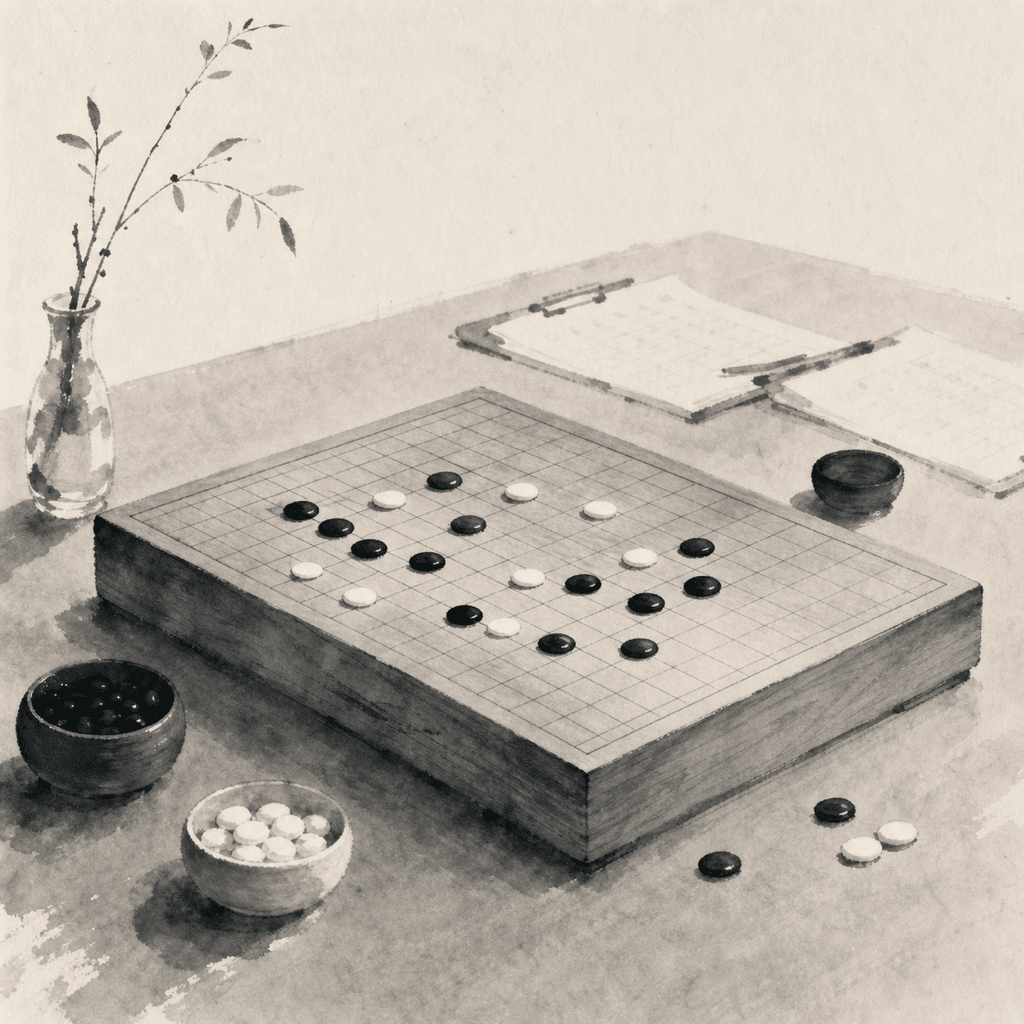
When you see a crosstable with seven wins from seven games, the easy mistake is to read it as a story of one player rolling through the field. But the quiet part of Czech Open 2026 was elsewhere. Sixty minutes plus five seconds. Swap2. A Swiss system. Seventy-three games that made the tournament’s rhythm unusually legible. The results were quiet. The information was not.
The seven rounds draw a clean outline
According to the RenjuNet event page, Czech Open 2026 was held on July 18 and 19, 2026, in Pardubice, Czech Republic. The event was Gomoku - Swap 2, rated, and listed as a Federation Title/Top Competition.
It was organized by AVE CHESS z. s. and Česká federace piškvorek a renju. Štěpán Tesařík served as both chief arbiter and tournament director. The page lists 22 players from the Czech Republic and Hungary, and 73 games.
The final standings are direct enough: Matěj Holub scored 7 from 7 for first place, Pavel Laube finished second with 6, and Lukáš Souček and Štěpán Tesařík followed on 5. The news surface is the ranking. The chess sense of it is stability.
Sixty minutes plus five seconds teaches you to slow down
Sixty minutes sounds generous. But in Gomoku, the complexity does not always arrive in the middlegame. Sometimes the second or third move, and the swap choices around it, have already tightened the air around the next twenty moves. The five-second increment keeps you alive. It does not think for you.
Under this time control, strong players are not merely calculating farther. They know where to go slow. In the opening, they judge whether a shape is worth accepting. In the middlegame, they decide whether an open three is a real threat or an invitation. In the finish, they treat every four-in-a-row as a cost.
For an amateur player, there is a useful lesson here: do not read “long time control” as “play every move slowly.” Refined tempo means staying modern and restrained in the unimportant places, then spending the time when the position turns.
Slow is not delay. It is allocation.
Swap2 turns the opening into a negotiation
The beauty of Swap2 is that it weakens the blunt edge of one-sided preparation. After one player places the first three stones, the other can swap, or add two more stones and let the opponent choose. It feels like a negotiation conducted in silence: you give me a shape, and I decide whether to take it.
So the first phase of a game is not simply a matter of playing near tengen. Contact around tengen can be intense, but Swap2 forces another set of questions. Is this shape too hot? Does it give the opponent two lines too directly? Does it leave the second player with a comfortable choice?
If you only look at the board, the opening may seem quiet. If you look at the decisions, it is the loudest part of the game. Every stone is testing whether the other player is willing to carry the future risk.
Seven straight wins are more like error control
Matěj Holub finished the seven rounds on 7 points, a bright result. But in this format, seven straight wins are rarely built only from a few beautiful kills. They look more like error control: in every game, you give the opponent one fewer clean chance.
Gomoku coverage tends to love the brilliant move. From a training perspective, though, a winning streak is better studied through ordinary turns: when not to rush a four, when not to mistake a blocked three for an open three, when to stop the opponent’s double-three idea before it can take shape.
That is the value a high-level open offers the ordinary reader. It reminds you that a result does not happen only in the final blow. It is polished, little by little, through many choices that look calm at the time.
A Swiss system reprices every round
The pressure of a Swiss system is particular. You are not fixed from round one against a single elimination line. Each round places you again inside a new score bracket. A win pushes you toward harder opponents. A loss makes the path back narrower.
So seven rounds are not seven isolated episodes. The way you spend time on day one affects how clearly you judge on day two. If you have just survived a long game, whether you still dare to enter a complex opening exchange in the next round becomes a real question.
This is why the 60-minute plus 5-second rhythm is worth noting. It is not the instinctive brawl of rapid play, and it is not the deep-sea dive of an ultra-long game. It is a tactile middle speed: long enough for errors to show, short enough for fatigue to matter.
Do not read the standings as one story
Pavel Laube finished second on 6, with Lukáš Souček and Štěpán Tesařík next on 5. That distribution makes the winner clear, but it does not mean the rest of the table is empty. The beauty of an open often lives between adjacent scores.
Players on 5 points have usually proved their stability, and also revealed a few fine cracks. Maybe one opening choice was a little too heavy. Maybe one defensive sequence lacked restraint. Maybe the breathing simply changed in the final twenty minutes of a long time-control game.
So when you read the news, there is no need to rush into writing a personality for every player. The reliable facts are already enough: 22 players, 73 games, two days, seven rounds. Put those numbers together, and the density of the tournament appears on its own.
Ordinary players can take three practice habits
First, when you practice openings, do not only memorize patterns. Practice the judgment of whether to swap. After you place the first three stones, ask yourself: if the opponent takes this position, am I satisfied? If the opponent adds two stones, can I still live with it?
Second, when you practice the middlegame, take the word open in open three seriously. It is not enough for the shape to look like a three. The next move must be able to create a sequence of threats that cannot be ignored. Many amateur mistakes come from treating a false open three as a true proposition.
Third, when you practice time management, give yourself one gentle rule: the first 20 moves may be quick, but the first time a two-line threat appears, you must stop. You stop not to look serious, but to make the board clear again.
Good Gomoku often begins as fewer mistakes.
The quiet value of this open
Czech Open 2026 does not need to be written as an extravagant legend. It is more like a polished sample: how Swap2 organizes opening fairness, how 60 minutes plus 5 seconds shapes thinking tempo, and how a Swiss system brings stability to the front of the room.
For someone who likes Gomoku, that is already interesting enough. Interesting is its own reason. The next time you try a game, consider looking slowly at the first three moves before you decide whether to take the position.