
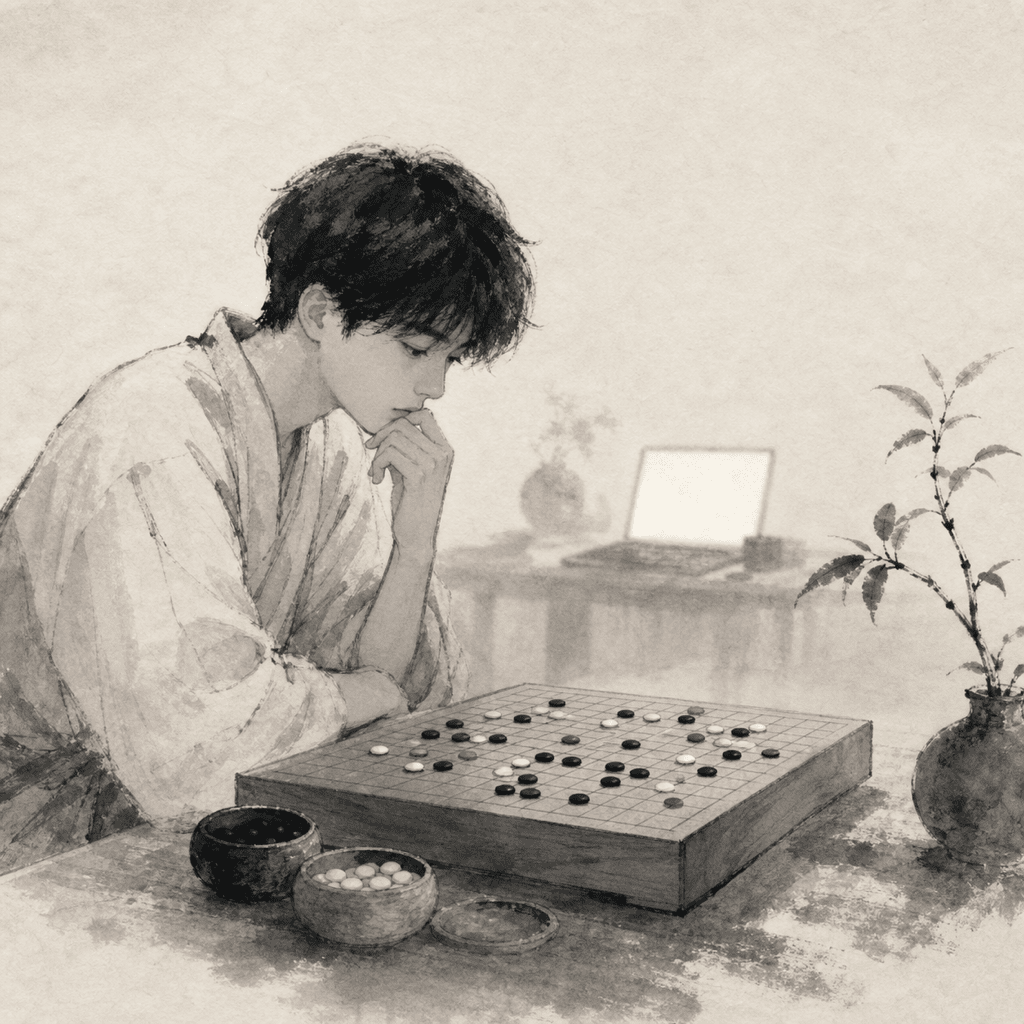
You may have seen this position before: a game has barely reached the middle stage, and the teenager on the other side of the screen has already threaded an open three, a four-in-a-row, and the defensive point into one line. You are still looking for the first move you missed. The 2026 World Renju and Gomoku Youth Cup is worth watching precisely because it puts that speed on a public board, while also exposing the training of young players, the work of online officiating, and the texture of watching live.
This is not just another online junior event
The official details for the online Youth Cup have appeared on RenjuNet. The event is listed as the World Renju and Gomoku Youth Cup, with the venue marked Tallinn / online, and play conducted through vint.ee. The dates are July 24 to July 30, 2026, and it is described as a rated international competition.
Put those words together and the shape becomes interesting. This is not a casual match arranged on a whim, nor a training game shown only to friends. It places junior games inside an international frame where they can be recorded, replayed, and compared. The games get tighter. The mistakes become easier to see.
What makes a youth tournament compelling is usually not the question of who already looks mature. The better part is watching players who still carry a sharp appetite for experiment, yet already know when to ease off near tengen, when to slow the game down because the position demands it. That is reason enough to watch.
The rule choice changes the weight of the first move
The Renju section uses the Taraguchi-10 opening rule, and that matters. It does not let Black and White snowball freely from the first move. Instead, it uses a more refined opening procedure to break first-move advantage into a series of choices that must be made and owned.
For a spectator, the most interesting stretch may be the first dozen moves after the opening begins. A quiet-looking stone may be avoiding the shadow of a double-three forbidden move. A move toward the edge may be saving room for a later diagonal open three. The rules are not background. They change the feel of the game.
If you usually watch only freestyle Gomoku, this tournament will remind you that Renju’s tension does not come only from being close to five in a row. It also comes from the points you cannot play, from seeing a killing move and having to admit that it is forbidden.
The points you cannot play also shape the game.
Swiss pairings keep every round alive
The event information says it will use the Swiss system, with nine rounds if the field is large enough. The virtue of a Swiss tournament is that, after the first day, the event does not collapse into only a championship race. Players on similar scores gradually meet. Each round becomes a kind of mirror.
That matters especially in a youth event. A child who loses in the first round is not reduced to playing out the schedule. In the third round, he may meet someone with a similar rhythm. In the fifth, he may finally repair the defensive lapse from earlier. Growth is not shaped like a single-elimination bracket.
The time control is 30 minutes plus 5 seconds per move. That pace does not leave only reflex, as blitz can. Nor is it so slow that every variation gets sanded flat. It brings calculation, instinct, and the emotion of the moment to the table at once.
Online officiating tests more than the network
This event notes that players and coaches will use Zoom, while spectators will watch on Twitch. That may sound like a technical detail. In practice, it helps determine whether an online tournament can remain restrained, transparent, and credible.
At an over-the-board table, order comes from the room: the arbiter nearby, the clock on the table, the opponent directly across from you. At an online table, order has to be rebuilt through process: identity checks, camera requirements, communication boundaries, and a clear procedure for what happens when a connection drops.
A youth event needs those boundaries even more. Not because young players are more likely to cause trouble, but because clear boundaries protect the game itself. The winner knows the win was clean. The loser knows that what needs review is the position, not the setting.
Watch how young players handle danger
Youth games are often sharp. But the moment worth lingering over is not whether they dare to attack. It is what they do when they see danger. Suppose Black already has the outline of a four-three threat. White does not simply block the brightest point. White first asks: will the next move turn another line into an open three?
You can choose one game and watch only three moments. First, who changes direction first near tengen. Second, who notices the shadow of a double-three first. Third, once byo-yomi begins, who is still willing to play a plain defensive point. This way of watching lasts longer than simply waiting for five in a row.
What I notice is that the maturity of strong young players often hides in not being greedy. When they can kill, they calculate one layer deeper. When they cannot, they accept the position. The next move becomes modern and calm. The board feels more worked over because of it.
The July calendar gives the Cup a useful frame
Not long after this Youth Cup, the 2026 Renju Team World Championship is scheduled for August in Yerevan. One online youth cup, one team world championship: viewed in the same summer, they make a compact comparison.
The Youth Cup shows how a new generation enters the international rhythm. The team event shows how mature sides balance stability and force. The first has fresh tactical ideas; the second has the structure left by long training. They sit close enough on the calendar to reveal the layers of the Renju ecosystem.
If you only want to watch casually, that is perfectly fine. Pick one or two streamed games. Write down a defensive point you did not understand. Afterward, return to the game record and look for the reason. It is a quiet way to watch, but it leaves something behind.
Where to start watching
You can find the event pages on RenjuNet: World Renju and Gomoku Youth Cup and the related entry RenjuNet tournament page. For rules background, see the RenjuNet rule page. Specific arrangements should be checked against later updates on the event pages.
I would suggest starting with the first round rather than waiting for the final. Early rounds make style easier to see: someone prefers pressure in the center, someone is willing to stretch the front, someone can still find a restrained move even in the final seconds.
Watch the style first, then the result.
When late July arrives, find a quiet evening and open a stream. Watch how they handle open threes, double-threes, and the first storm around tengen. If one move makes you stop, play a game yourself.