
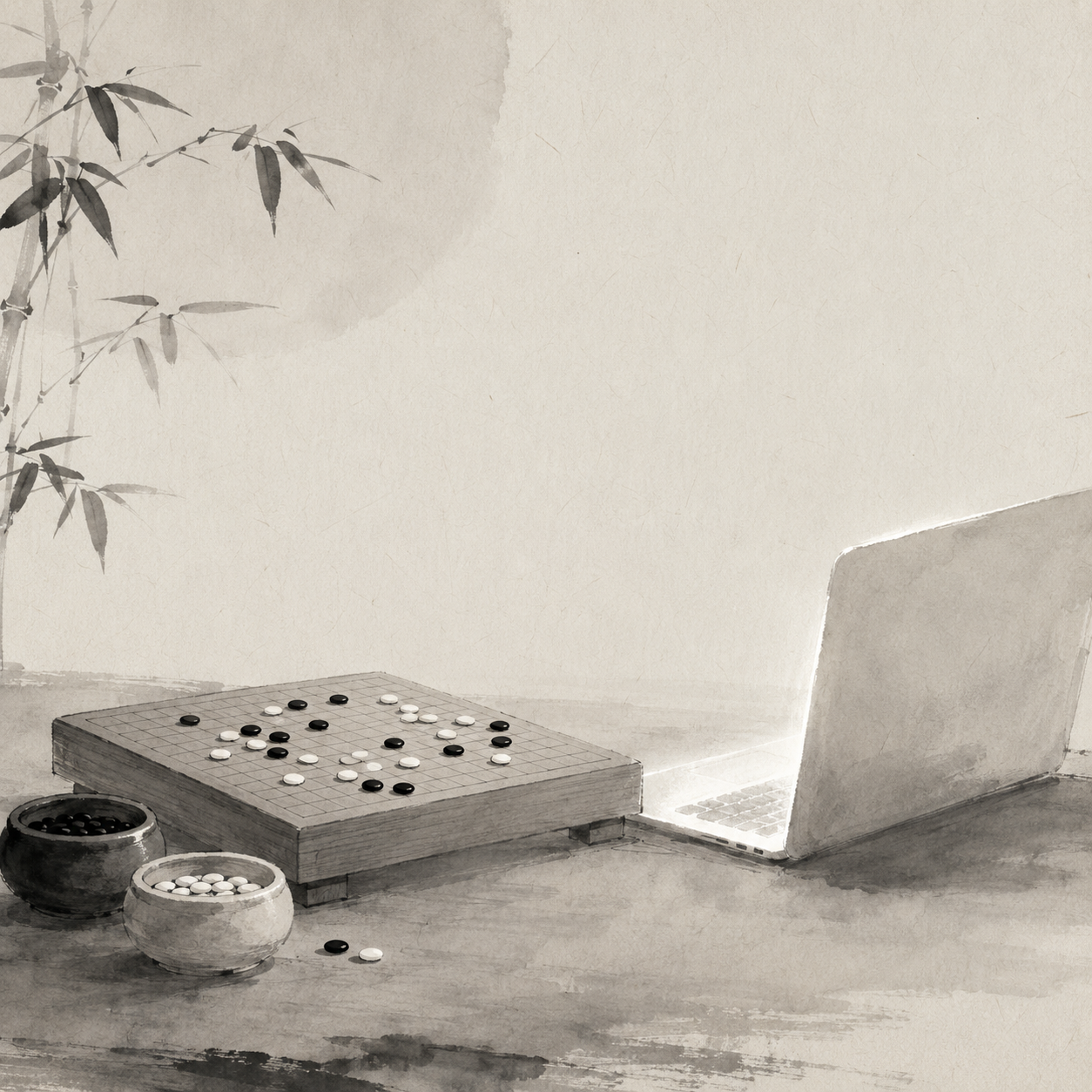
If you are used to imagining a tournament as one room and one long table, the 2026 World Renju and Gomoku Youth Cup is a quiet reminder: a young player’s board can now be unfolded by a network cable. The stones still land on intersections; the edges of watching, communicating, and preparing have simply become lighter.
A tournament that begins with distance
RenjuNet lists the World Renju and Gomoku Youth Cup (online), with Tallinn, Estonia as the place, July 24-30, 2026 as the dates, and both Renju and Gomoku on the program. It is not a youth event that gathers everyone in one city. It distributes one shared board across many screens.
The point is not merely that it is online. For young players, online play lowers the travel threshold and brings international games earlier, while asking them to learn another order from the beginning: log in on time, verify identity, adapt to the platform, and stay focused under camera and referee rules.
Rules keep their weight; the platform changes the touch
The event page marks the Renju rule as Taraguchi-10, lists it as a rated international competition, uses a Swiss system, and gives a time control of 30 min + 5 sec/move. The interesting part is that the rules do not become lighter just because the venue is online.
Players still face opening choices, tempo control, and middlegame pressure. What changes is the texture: there is no wooden click of a stone, and a pause may come from the network as much as from thought. A good online event lets those external changes recede so the game can stand in front again.
Distance changes; the weight of the move does not.
The gift of youth events is meeting the world early
Youth events are often read as tables of results: who scored, who advanced, who reached the podium. In a smaller international game like Renju or Gomoku, they also do something else: they tell a young player that people elsewhere treat the same board with the same seriousness.
That changes the imagination of training. A child is not only memorizing patterns in a local classroom, but feeling real differences in rhythm, openings, and defensive patience. The board remains square; the experience gets wider.
Read schedule details with restraint
For now, the page also says “Regulation is not final,” and its registration dates are not fully consistent. The right things to put on a calendar are the event window, project structure, platform, and rule set; the wrong thing to amplify is any detail that still needs final confirmation from organizers.
That is also the restraint tournament writing needs. State what is firm, leave space around what is not. Responsibility to readers is not filling every field; it is knowing which fields should not yet be fixed.
A cup inside a dense 2026 calendar
The same RenjuNet tournament list also places Dalian’s Youth World Championship, Yerevan’s Renju Team World Championship, and Yerevan’s Gomoku Team World Championship in the 2026 summer calendar. The online Youth Cup is not isolated; it sits as a lighter node among a dense run of international events.
That gives it a particular role. It is not as heavy as a world team championship, but it may become a first cross-regional encounter for many young players. The clearer the entrance, the easier it is for the next game to continue.
Why WUZIQI should record it
The WUZIQI blog does not need to turn every item of news into a bulletin. What is worth keeping is the small change beside the board: how rules are inherited, how platforms lower thresholds, and how young players bring serious games into ordinary devices.
That change is quiet, but modern. It is close to the atmosphere WUZIQI wants to keep: calm, restrained, tactile, and clear. Beauty is reason enough; a well-arranged online event can also make the order of the game easier to see.
Before the first move, make the entrance clear
The final record of a youth online event will be its results, but the longer-lasting part may be the respect it teaches for rules, time, and remote cooperation. The beauty of the board does not come only from a line; it comes from every move being treated with care.
When the event begins in July, the most interesting thing to watch may not be the fastest win on screen, but how young players place one stone where it belongs inside a quiet interface. Try one game, and watch more slowly.