
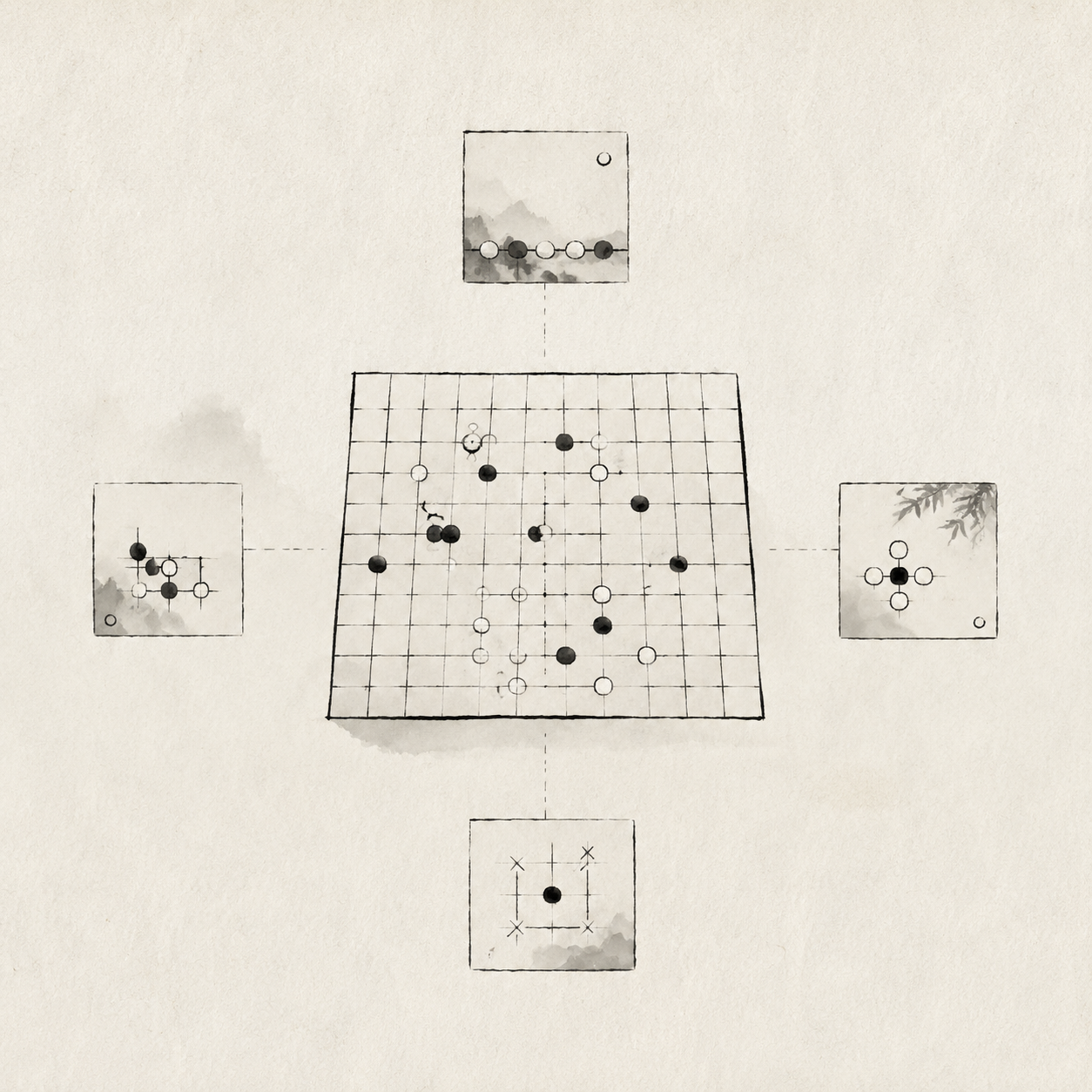
You open the schedule and see freestyle, standard, renju, and caro listed inside the same Gomocup 2026. Your first reaction may not be excitement, but a small confusion: is this still the same game of Gomoku? The programming tournament that starts today offers a clean way in. Rules are not footnotes. They change the weight of the opening, the speed of attack, and the character of a game.
Gomocup 2026 starts today. Begin with the basic facts
According to official Gomocup information, the 2026 event takes place June 5-7. It continues the recent format of grouping several competitions together, covering freestyle, standard, renju, and caro, and remains an annual tournament for Gomoku and Renju programs.
This is not just a showcase of who can calculate deeper. The official notes also say that openings are balanced to reduce first-move advantage. Programs face memory and size limits as well: for example, 1GB of memory, a 256MB size cap, and the rule of one program per author. The more specific the constraints, the clearer the game begins to feel.
More interestingly, Gomocup 2026 allows a single compressed package to include multiple rule-specific executables, distinguished by freestyle, standard, renju, caro, and board-size suffixes. In other words, entrants are allowed to admit something important: one line of thought may not fit every rule set.
Freestyle is the most direct game: make five and you win
freestyle is closest to what many people understood as Gomoku when they were children: the first side to make five in a row wins. Its beauty is its directness. It needs almost no extra explanation. Every line on the board says the same thing: connect five stones.
But direct does not mean simple. With fewer limits on Black and White, the first-player advantage becomes more visible, and opening choices become more delicate. A quiet move near tengen may quickly grow in two directions. A handsome expansion along the edge may give up half the board’s breathing room.
When you watch freestyle, keep your eye on the first ten moves. Do not rush to ask which side is “stronger.” Ask first which side has kept more directions open. Beauty is reason enough; but in freestyle, a beautiful shape is often beautiful because it has not yet trapped itself.
Standard tightens the feel of Black’s play
standard usually restricts how Black can win: Black needs exactly five in a row, and an overline does not count as a win. White can still win with five or more in a row. The difference is small, but it is enough to change how attack and defense are judged.
In freestyle, an extended line may still be a source of power. In standard, if Black stretches too far, the shape may become invalid. You will see some programs stop trying to make lines as long as possible and instead hold back at positions that can still be converted.
Change the rule, and the shape breathes differently.
That is why standard is worth watching on its own. It slightly suppresses the impulse to rush out, making the refinement of shape matter more. Black cannot merely ask whether more stones are connected. Black must ask whether this line is exactly where it needs to be.
Renju turns first-move advantage into a language of forbidden moves
renju is built around weakening Black’s first-move advantage through forbidden moves. Common concepts include Black’s forbidden double-three, double-four, and overline; White carries no comparable burden. A game shifts from “who can create the threat first” to “who can make threats without crossing the line.”
Picture a concrete position: Black wants to make an open three in the center, while also using another diagonal to form a second open three. If the move creates a double-three, then in Renju it is not a beautiful attack. It is a point that cannot be played. Both the player and the program have to calculate “good shape” and “legal move” at the same time.
So Renju feels more like fine workmanship. It does not remove attack. It makes attack pass through a polish: you have to find a move sharp enough to matter, but not so sharp that it crosses the boundary. Such games are often slower, and they often leave more aftertaste.
Caro redefines the finish with a blocked five
caro, as played in many regions, pays attention to whether both ends of a five-in-a-row are blocked. Roughly speaking, simply lining up five stones does not always equal victory. If that five is sealed at both ends by the opponent, the judgment can change. The exact implementation depends on the tournament rules, but the direction is clear: the finish line has been given a new condition of openness.
That changes the value of defense. Facing a line that is about to become five, the defender is not only asking, “Can I block one end in time?” The defender may also ask whether the opponent’s line can be deprived of an open exit. The board is no longer measured only by length. It is measured by the air at both ends.
If you usually play only freestyle rules, caro may feel a little unfamiliar. But that unfamiliarity is useful. It reminds you that the beauty of Gomoku is not only in connecting stones. It is also in the empty points beside the line.
Time controls reveal a program’s temperament
The official information mentions different rhythms, including fastgame and final leagues. A fastgame may allow 5 seconds per move and 120 seconds per game; the final level can reach 300 seconds per move and 1,000 seconds per game. Change the time, and the same program’s temperament is exposed.
Fast games test pruning, instinct, and emergency judgment. A program has to decide, in a very short time, which branches are worth keeping and which shapes can be ignored for now. Slow games are more like polishing the board until it shines: long plans, forbidden-move boundaries, and complex killing lines all have room to unfold.
This is also why program tournaments are more interesting than they may first appear. They do not have the expressions and pauses of human games, but they leave traces of decision-making in the shapes. A point avoided again and again, a four-in-a-row left unpushed for a long time - both may be acts of calculated restraint.
Balanced openings are meant to make the middlegame worth watching
The detailed Gomocup information says openings are balanced to reduce first-move advantage. That design matters. Gomoku naturally favors the first player. If the opening is too free, the result may be decided too early by the first cluster of stones.
A balanced opening is not meant to erase style. It is meant to delay style until it can be compared more fairly. In the middlegame, a program’s understanding of open threes, four-in-a-row threats, forbidden moves, blocks, and tradeoffs begins to show itself. What you see then is not merely an opening bonus. It is judgment under rules.
There is another direction worth noting this year: the official site mentions a planned unlimited tournament that will use Swap2 and impose no program-size limit. That will be a different kind of testing ground - more open, and closer to the question of what the game becomes once the limits are removed.
When you watch Gomocup today, bring one question
Do not memorize the four rule sets as four unfamiliar terms. A better way is to watch with one question in mind: what impulse does this rule change? Freestyle amplifies direct attack. Standard trims Black’s overline. Renju restrains the first player’s excess. Caro makes the space at both ends of a five-in-a-row matter.
Seen this way, Gomocup 2026 is not just a program leaderboard. It is like a board divided into four kinds of light. The same black and white stones reveal different textures under different rules. Watch a few games quietly, and you will better understand why Gomoku holds the eye.
If you have time today, choose the rule set you know least well and try one game. Do not aim to win at first. Just notice the move where you begin to feel uncomfortable. That is often where the rule truly begins to speak.