
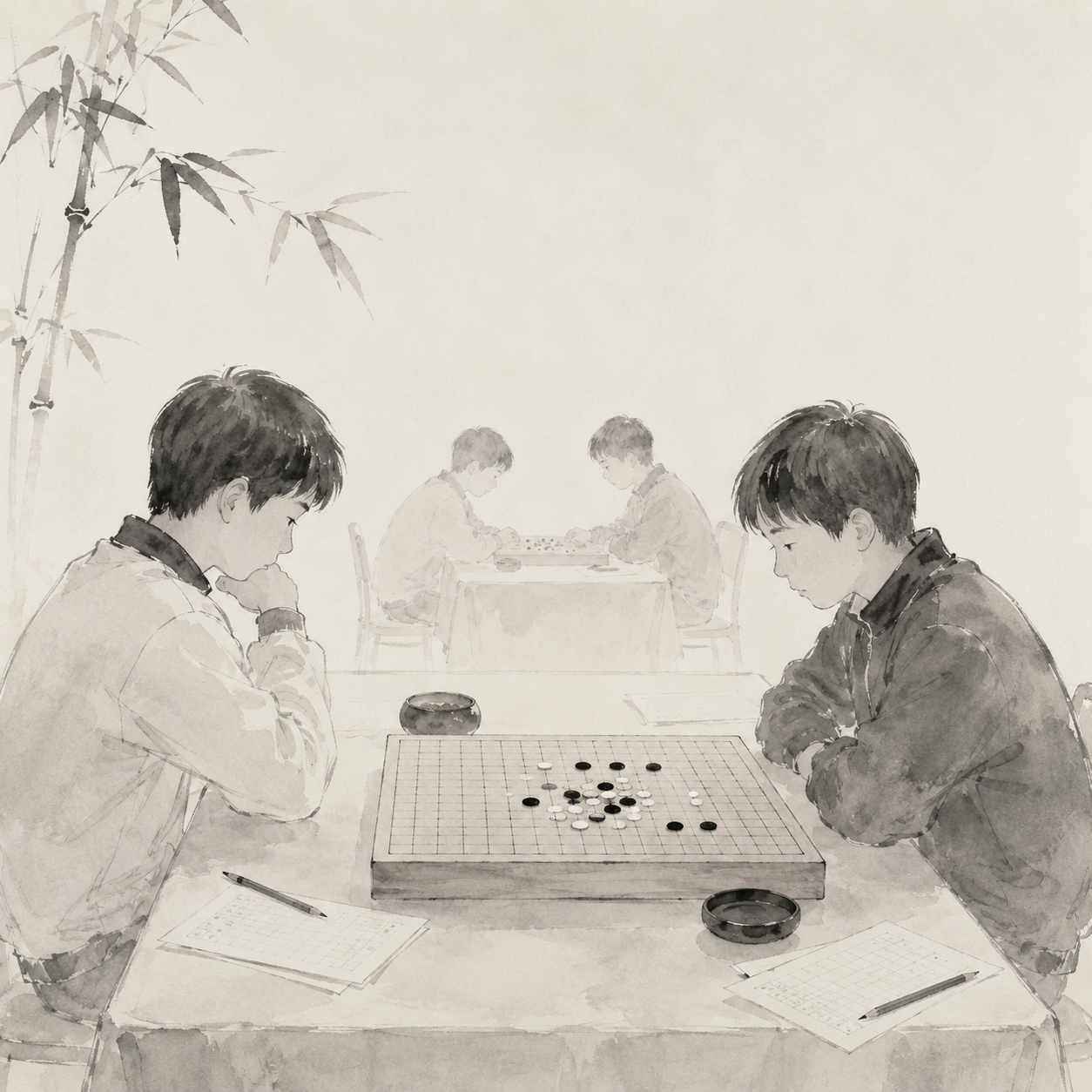
When you see the words “Youth World qualifying tournament,” you may think first of standings. But in Renju, the more revealing question is often not who wins fastest. It is who, while still young, can learn to play a move calmly, with restraint, and with a reason that can be explained.
A Qualifier Is More Than a Path to the Final
RenjuNet’s schedule lists several groups of the 2026 Youth World qualifying tournament in Anji, China, running from May 29 through June 1, with the opening rule marked as Taraguchi-10. It is not the trophy moment. It is a window into the quality of training.
A qualifier filters out some of the noise of the day and magnifies ordinary habits: whether the opening is steady, whether the calculation is clean, whether a player can slow down when pressed. The growth of a young player is often hidden in these small, unshowy places.
Taraguchi-10 Turns the Opening Into a Choice
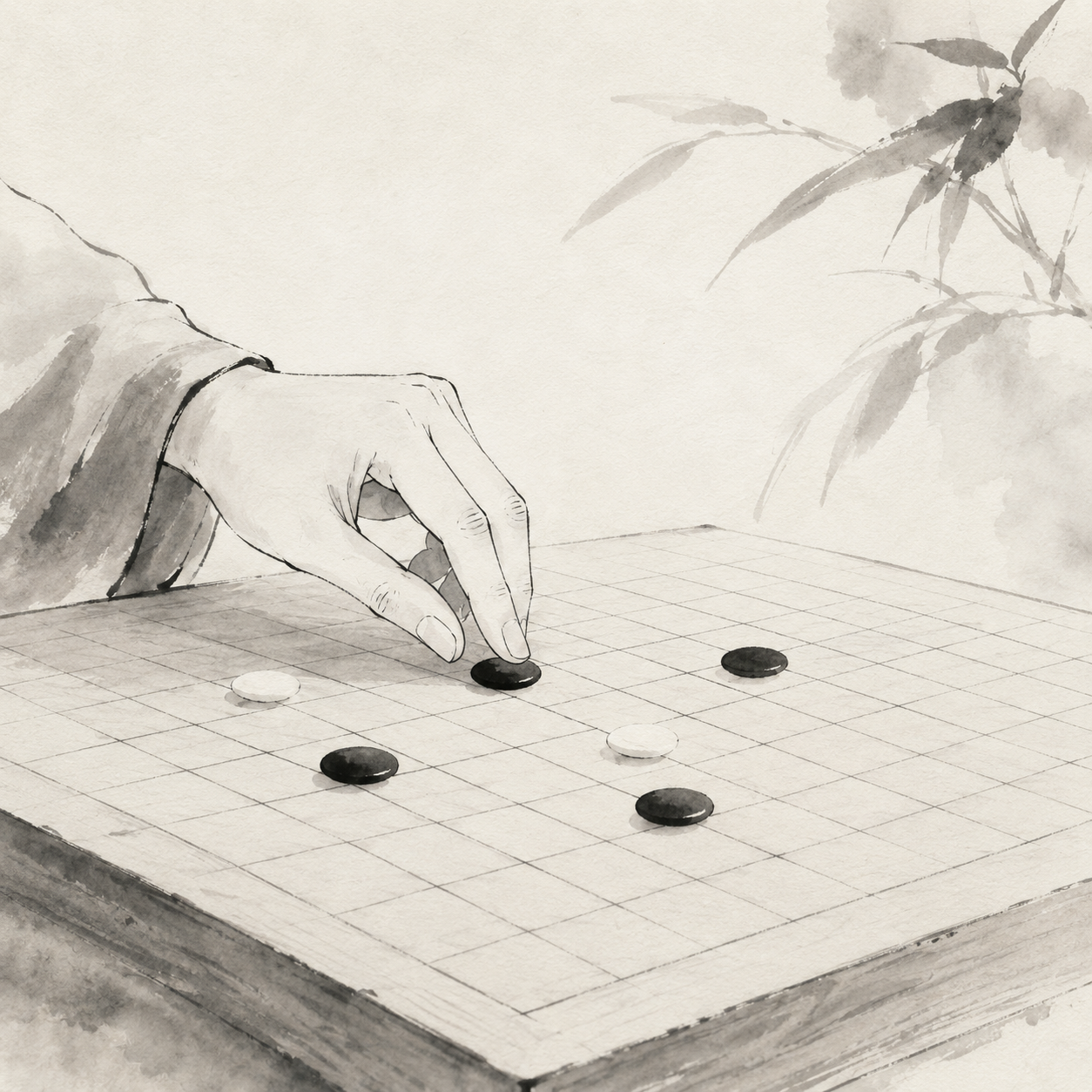
Taraguchi-10 is one of the familiar opening rules in Renju. Its purpose is not to make players memorize more tables. It places the first-player advantage inside a more detailed procedure, so that both sides face choice, constraint, and exchange from the start.
For young players, that kind of rule has real teaching value. You cannot simply pile pressure near tengen by instinct. Nor can “I know this position” serve as the whole answer. From the first phase, the opening asks you to explain: why here, and why now.
A good opening knows how to breathe.
Anji Reminds You That Youth Chess Is Not a Smaller Adult Event
It is easy to treat youth events as a rehearsal for adult competition. That view is too crude. Youth play is more like a bright training room: mistakes appear directly, and corrections can appear just as quickly.
In a single game, a child may be extremely sharp in local calculation but not yet know how to wait. Another may have memorized patterns but still struggle to rebuild a position in unfamiliar territory. A qualifier puts these differences plainly on the table.
Watch First for the Ability to Slow Down
The easiest thing to misread in youth games is speed. A quick hand does not always mean confidence; a slow hand does not always mean doubt. What matters is whether, once the position becomes complex, the player can still lay out the candidate points one by one.
If you look only at the result, many details disappear. Try watching what happens after the opponent creates pressure: does the player first check the relationship among a half-open three, an open three, and a four-in-a-row? Then ask whether a local gain has cost the whole board its breathing room.
What Coaches Want Is Language You Can Review
If a move can only be explained as “it felt right,” training has little to build on. The most valuable skill in the youth stage is translating vague instinct into reviewable language: where the threat is, where the defensive point is, and where the next variation begins.
That is also why Renju remains more watchable than many faster games. The board is small and the lines are spare, but every stone asks you to take responsibility for a reason. Beauty can be a reason. In a match, though, the reason still has to survive review.
Bring the Qualifier Back to Your Own Board
You do not have to wait for a world event to practice these things. Before your next game, give yourself one small constraint: before every key move, name at least two candidate points, even if you are saying them only to yourself.
The habit will make your game a little slower, and also quieter. You will be less likely to be dragged around by a single threat, and more likely to notice the space forming on the other side of the board.
Young play is valuable because it can still be corrected.
Beyond the News Is a Finer Line of Growth
The Anji qualifiers will not have the built-in drama of a championship match. But they offer another way to watch: to see how young players, between rules, pressure, and review, slowly turn feel into judgment.
If you want to play a serious game of Gomoku soon, borrow the standard of a youth event: less rush to prove yourself, more effort to explain clearly. Try one game and practice only that.